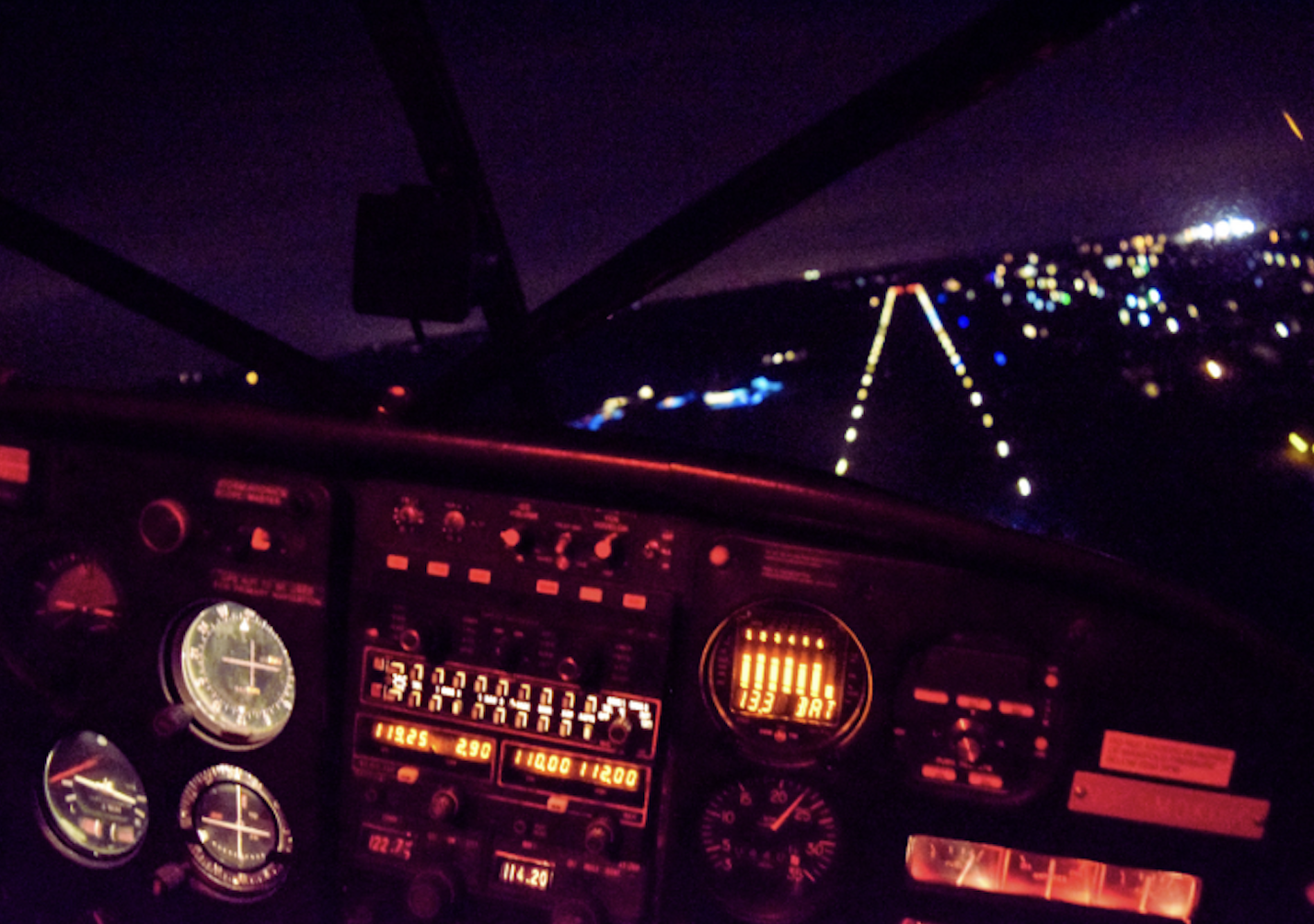
Part of advancing as a pilot is improving your ability to safely complete challenging night flights. The night cross country required for obtaining the Commercial pilot certificate is a great place to start this conversation. Please note that these ideas are not a substitute for training with a qualified CFI, so use them as a starting point for discussion with your instructor before attempting anything.
There are key differences between the night cross-country requirements for Private versus Commercial certificates, and I propose that (nearly) all pilots might want to grab an instructor and replicate the Commercial version - even if you already have the certificate, or if you never plan on getting one. For those of you actively pursuing your Commercial certificate, this will shed some light on what to expect from your night XC.
Let’s start with the regs for the Commercial night XC requirement:
14 CFR 61.129 (a)(3)(iv): One 2-hour cross country flight in a single engine airplane in nighttime conditions that consists of a total straight-line distance of more than 100 nautical miles from the original point of departure;
Since this falls under the “20 hours of training” subpart, it is performed with an instructor. This flight, along with the 5 hours of solo night VFR required for the Commercial certificate under 14 CFR 61.129 (a)(4)(ii), was one of the most rewarding facets of my Commercial pilot training, and it completely transformed my confidence, competence, and enjoyment of night flying.
Let’s back up a bit and talk about the night flying requirements to get a Private certificate. All Private pilot applicants are required to perform a night flight with their instructor to an airport greater than 50 nautical miles (NM) from their home airport. For several reasons, this flight is often conducted as a nighttime repeat of one of the student pilot’s daytime cross-country flights. Much of the geography, airspace, airports, frequencies, obstacles, potential emergency landing spots, and most other “gotchas” are a known quantity. The flight time is short enough that it will typically be done as a touch-and-go without needing to accomplish ground operations at an unfamiliar airport in the dark. Even with these “easy mode” options in place, this can still be a challenging and often intimidating flight for student pilots. That cross-country, along with the other fairly meager night requirements listed in 14 CFR 61.109(a) of 10 takeoffs and landings and 3 hours total night flying time, gives the freshly minted private pilot a fighting chance, but it still isn’t really representative of the full gamut of challenges that come with safely operating an aircraft at night.
The Commercial requirement essentially doubles this distance, while still keeping the instructor along. Why is this valuable?
First, doubling the required distance to 100NM introduces several dimensions of pre-flight planning that may have been less critical for the shorter night flight. The first is the weather. When was the last time you considered your personal minimums for a night flight? You may feel safe landing in a 15kt crosswind during the day, but diminished ability to judge distances at night might make you rethink that number in the dark if you haven’t practiced it recently. What about minimum cloud ceilings? Marginal VFR conditions that are already hazardous during the day can become significantly more dangerous at night. Conditions can change vastly over a 100NM distance, and the ability to judge cloud clearance is often almost non-existent until you’ve entered the soup. An aircraft squawk or deferred maintenance item that was judged an acceptable risk on typical flights may feel less acceptable when considering the desolate areas that you’ll be flying over at night. There is no set of one-size-fits-all answers that applies to all pilots, aircraft, and environments, but a pre-flight discussion on these topics and more with a good CFI can be eye-opening.
A night flight of any significant distance raises many questions about route and altitude planning to best balance maximizing feasible landing options in an emergency, maintaining safe clearance from clouds and obstacles, fuel planning, and taking physiological issues and needs into account.
Don’t get me wrong – night flights can provide some of the most rewarding time that you’ll spend in an aircraft. There is often calmer air, less traffic, and amazing views at night. Being able to safely and confidently operate an aircraft throughout all phases of a night flight is also a huge boost to your overall confidence and capability as a pilot.
Personally, I treat almost all night flying as Instrument flying whenever possible - especially when the plan is to cover any kind of significant distance, but this isn’t always possible - and sometimes a decision must be made whether it is safe to continue VFR. This is another aspect to discuss with your instructor.
Night flying isn’t intrinsically hard, but it does create a higher probability of needing a “Plan B” while simultaneously making it more difficult to create that plan on the fly. For example, increased difficulty judging weather at night raises the odds of needing to divert to an alternate airport, while the dark cockpit can make it more difficult to locate information about that airport – including any obstacles that may be invisible in the dark, instructions for turning on pilot-controlled lighting, and NOTAMS that may become more critical without full visual acuity that you are accustomed to during the day.
Fatigue from simply being awake later at night can be compounded by the increased impact of reduced oxygen on our vision at night, as well as by other common night visual illusions such as autokinesis (in which fixating on a light source causes apparent motion of that light), false horizons (often created by clouds or rows of ground lighting at night), or simply annoying and disorienting flashing in the airport environment caused by other aircraft with their strobes on, or Runway End Identifier Lights (REILs) turned up too high.
Here are a few ideas for getting the most out of your long night training flight:
Choose your instructor wisely. You want someone who will help you stay safe if anything goes wrong, while also maximizing the learning potential of the experience.
Emphasize the pre-flight brief. As discussed above, the details of this will vary depending on your experience, aircraft, flight environment, and other factors.
Set the expectation that your instructor shouldn’t make things unrealistically easy for you by planning your route, handling all of the radio calls, or otherwise reducing your workload too much (unless it becomes a safety issue). This flight should be a building block toward boosting your confidence and competence in completing similar flights on your own or with passengers when you are ready.
Don’t skip the post-flight brief. You may be really tired by the time you get home and put the plane to bed, but make sure that you and your instructor at least take a few minutes to record notes that you can discuss at a later time. Lessons gleaned from this flight can be invaluable. Don’t lose them!
Flying at night adds additional risks and challenges, but it doesn’t need to be scary. Developing your skills and competence in this facet of aviation can provide benefits that will apply to nearly everything else that you do in the cockpit.
